Customer Interview

How America's Service Line moved fleet compliance off spreadsheets
America's Service Line, the private fleet for American Foods Group, runs 200+ refrigerated trucks with drivers out for weeks at a time.
Chris Kirby, Senior Manager of Safety and Compliance, explains why hands-free matters under a zero-tolerance cell phone policy, and what changed when compliance reminders reached drivers in the cab.
Watch the Interview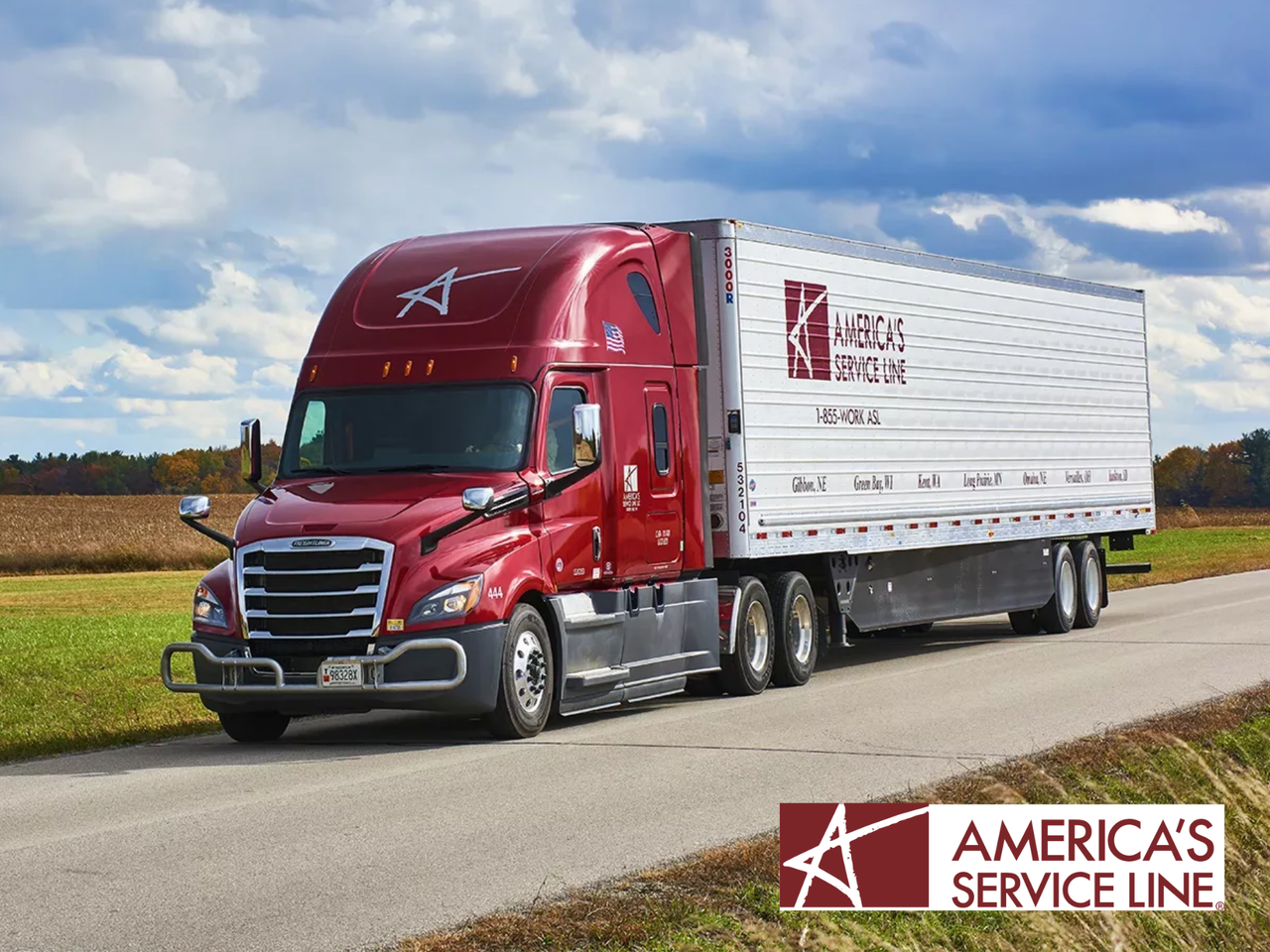
What changed
- fewer hours-of-service clock violations when drivers heard the warning in time
- 51%
- faster log certifications with real-time reminders
- 4x
What you'll see
- Why a phone call was the fastest way to reach a driver, and why that sat badly with a zero-tolerance cell phone policy.
- How hands-free access to dispatch details keeps a driver focused at an unfamiliar exit, gate, or dock door.
- Why hours-of-service and uncertified-log problems at a 24-hour reefer fleet surfaced only after the fact, and what in-cab reminders changed.
- What Chris Kirby tells other safety leaders to test before adding anything to their tech stack.
Highlights
- Reaching a driver meant picking up the phone
- With a main terminal in Green Bay, a satellite in Grand Island, and drivers out for weeks, urgent changes like a new pickup number or a confirmed appointment went out by phone call. A telematics message worked, but the phone was faster.
- A zero-tolerance cell phone policy, and a phone as the main channel
- The fleet bans cell phone use behind the wheel, which made the phone an awkward way to communicate. With Storyboard, a driver approaching an unfamiliar exit can ask for the pickup number or check-in gate and hear the answer without touching a device.
- Hours-of-service problems surface after the fact
- Violations usually start with something unexpected: a delay, 30 minutes left on the clock, and no safe parking nearby. Drivers stay logged in for weeks, so tablet workflows could not prompt them to certify logs. Audible reminders now cover uncertified logs and approaching hours limits.
- Less managing by spreadsheet
- The fleet has seen improvement in hours-of-service and uncertified-log compliance. Every manual report it no longer has to pull frees time for one-on-one driver coaching.
- Advice to a safety leader considering this
- Chris Kirby had no appetite for more technology. The pilot had to prove the product worked and that support was there when something went wrong. What he found was a responsive partner rather than a help ticket that sits for a week.
Full transcript
Prefer to read, or cannot watch right now? The whole conversation is here.
Read the full transcript
@0:05 · JP Gooderham (Storyboard)
Hey there, folks. This is JP Gooderham, CEO and founder of Storyboard, the hands-free system for drivers. I’m really excited to be joined today by one of my favorite people that I’ve ever met in the industry. And I’m going to have him introduce himself. Chris, thank you for joining the Storyboard podcast.
@0:23 · Chris Kirby (America's Service Line)
Hi JP and everyone else. Excited to talk to you today. That’s a pretty large introduction there. I hope I can live up to that. I am, my name is Chris Kirby. I am the Senior Manager of Safety and Compliance for America’s Service Line. America’s Service Line is a private fleet. We are the private fleet for American Foods Group. Our parent company is a beef producer, a large beef producer. We are based in Green Bay, Wisconsin. The accent you hear on me is not Wisconsin. I’m native to North Carolina, but I moved to Wisconsin several years ago and found a home at America’s Service Line. We have about 220 trucks in our fleet, and we are a traditional OTR fleet doing full truckload reefer freight. Most of our drivers stay out two weeks at a minimum. Some go much longer than that. So they’re hauling freight all over, basically east of the Rockies. A large part of our corridor is from the upper Midwest and Wisconsin and Minnesota across to the east coast. So the Jersey and New York and Pennsylvania areas, we beat a pretty big path through that route. So based in Green Bay, as I said, and we have a terminal location in Grand Island, Nebraska.
@2:02 · JP Gooderham (Storyboard)
Chris, I got two questions for you. [Unclear] since I’ve been to Green Bay. Has spring weather broke at all yet? What’s the weather like at this point?
@2:10 · Chris Kirby (America's Service Line)
It is getting there. We’re sitting here on April 9th. We’re probably, yesterday we probably hit 60 degrees. Today I’m looking out the window. It is sunny and supposed to be around 60 again, so I think we’re good. That thing could, that winter thing can rear its head at any point. In fact, we had accumulation of snow just about a week ago that melted quickly. But in Wisconsin, you’re never really clear from it until Memorial Day.
@2:45 · JP Gooderham (Storyboard)
And then, you know, before we dive in, and thank you for the background on yourself and America’s Service Line. You know, like I said at the top, I’m really excited to speak with Chris today, who I think is a real thought leader for a lot of safety teams. And I’ve had the opportunity to see him speak at places like NPTC. I think it’d be fair to say this: that ASL, I always see ASL winning awards, right? This is, you know, what’s a recent one that’s come up?
@3:15 · Chris Kirby (America's Service Line)
We are 2024’s National Private Fleet or Private Fleet of the Year from the NPTC in 2024. We finished first place in the Fleet Safety Award through NPTC in 2025. No spoilers yet, but looking pretty good for 2026 as well. Yeah, we’ve got we’re one of the best fleets to drive for. We’ve been designated that for two years in a row. We are an organization that has had a lot of success and it’s really on the backs and the efforts of our drivers, who we think are the very best in the industry. We have very, very good CSA scores, which leads us to be able to take insurance at a lower level. We actually are receiving a decline in our premiums this year, which is really, really unusual in the industry. And it’s really just based on recognizing that drivers have a tough, tough job. And their most difficult or most challenging thing that they face every day are the actions and driving behaviors of other drivers. And you can say that about any trucking fleet out there. That’s always their most persistent challenge: are the other drivers who hover in your blind spot and do all those things. So we thankfully and very consciously, you know, coach our drivers on driving behaviors and speeding, and we’ve done a lot of effort. We have a group of drivers that are really interested in performing well and doing the best job they can. That starts with hiring the right people. So that’s a lot more than you wanted, than you asked for. But yeah, our fleet is very professional and represent us very, very well.
@5:25 · JP Gooderham (Storyboard)
I’m an outsider, the view from the cheap seats, but it’s the reason I brought that up, Chris, is just having worked with America’s Service Line for some time, it’s really impressive the level and character, as you mentioned, not only of the management team, but of your fleet of drivers and getting the opportunity to work with them has been great. So let me ask you this, you know, kind of turning to a technology investment that your company has made in the last year. We’re very fortunate to have now, it’s kind of crazy, it’s been almost a year since we got our first drivers on the road. Before Storyboard, what was the world like as far as typically how driver managers or the safety team would interact with drivers, you know, when they’re doing their day to day?
@6:09 · Chris Kirby (America's Service Line)
Well, that’s been a challenge for us, and it is for any trucking fleet, but especially one that has basically a main terminal in Green Bay and a smaller satellite terminal in Grand Island, and our drivers are all across the place. And they’re out for more than a couple weeks at a time. So excuse me. You know, in the old days, it was a matter of sending a message or calling a driver when you needed something. Operations change frequently. Loads change, plans change, drivers get delayed. All the things that happen in the life of a driver. You know, and there’s a lot of communication and data and information that needs to be passed from our operations team to our fleet of drivers. In the past, it was a matter of picking up the phone and giving them a call. You know, we would check to see if they were in sleeper berth just to make sure we’re not interrupting their rest before we make that call. But in some cases, you can’t always do that. Sometimes you’ve got to pass urgent communication to a driver who needs to know that next pickup number or needs to know that his load’s changed or needs to know the appointment’s been confirmed and all those things. So it was a matter of either giving them a call or sending them a message in our telematics provider’s platform, which works, but the quickest way to get a hold of them was old-fashioned picking up the phone and giving them a call.
@7:45 · JP Gooderham (Storyboard)
So that’s the backstory. I think starting in the going into the fall of last year, we started launching some drivers using Storyboard and then expanded from there. Why, as a forward-thinking safety director who thinks about all these different elements, not just of what’s important for safety, but the driver experience and the way drivers operate. Why was using a hands-free system with Storyboard important versus, say, getting Bluetooth headsets for everyone or any of the other alternatives that you might think about?
@8:18 · Chris Kirby (America's Service Line)
Well, the advantage of Storyboard is, you know, being able to communicate hands free. There’s no doubt the industry is under attack from the plaintiff’s bar. We all know that. We’ve heard about nuclear verdicts now for about 10 years at least. And that’s not slowing down. And so, as an organization that needs to protect, my job is to protect the company against risk. That includes not only driving behaviors from our drivers, but it includes thinking about the risk of litigation. You know, you get involved in an accident, even if it’s not your fault, you were doing nothing wrong, but you’re still going to get potentially a lawsuit on your doorstep, and that plaintiff’s lawyer is going to start looking in all the cracks. And so, your cracks better be clean. And so, you owe it to your organization and your drivers to insulate them from as much risk as possible. Obviously, we have a zero-tolerance policy for cell phone use. So it seems contradictory to have that policy in place and then use a primary method of communication with our drivers as the cell phone. Now, yes, they can use hands-free or a Bluetooth headset, and many of them do, and that’s perfectly fine. No problem. We don’t want them touching the device and the cab of the truck when they’re out there operating amongst the people who you have to share the roads with. You know, it’s not always easy. And so the attractiveness of Storyboard is the ability to communicate hands-free, one, but also, you know, that driver that’s sitting in the cab of the truck who’s driving down the road and needs information about his dispatch. Well, and he’s approaching the exit and he can’t remember, he hasn’t been here before, he hasn’t been there to this location in a couple months. And so he’s forgetting what door to check in, what gate to check in, what the process looks like for checking in. Well, with Storyboard, he has the ability to summon that data, summon that information without touching the device. So he can continue doing his job, what he needs to do, but he can quick, you know, a check check, what’s my pickup number, and summon a response audibly from Storyboard on his tablet. So that’s a game changer. We want to give every driver the opportunity to be successful. And what is success? Success is delivering the load at the customer’s expectation in a method that does not harm the freight, does not harm himself, does not harm the equipment or anyone else. So, accident-free and on time, and claims-free. And the only way to do that when they’re operating in that environment, or not the only way, but one of the ways that’s beneficial to them is being able to access information, data, about their dispatches without picking up a cell phone or picking up a headset or being mentally, cognitively distracted by the act of making a phone call. Cognitive function exists best when we’re focused. And we believe our drivers and people should be mindful and using a large amount of mindfulness when they need to be focused. I always say when the driver sits in that seat and they hear the click of that seatbelt, it’s go time. You’ve got your helmet on, your shoulder pads on. It’s time to be focused. And being focused is when you’re being distracted by all the things, right? So this happens to me as a driver. It happens to you as a driver. It happens to everyone as a driver. You hear that cell phone or you think about that cell phone and it becomes a temptation. And now all of a sudden your mind’s wandering. And all of a sudden your mind is not on the job, on the focus, on the task of driving that 80,000-pound vehicle, it’s being challenged by other things. And so, we, you know, Storyboard gives us an option to eliminate a driver picking up and handling a device, a cell phone, while they’re driving, they can still get the information that they need, they can still hear their dispatches, they can still communicate with their driver manager without having that temptation.
@13:03 · JP Gooderham (Storyboard)
Chris, I really like what you said around how responsible drivers have to be for the behavior and the actions of not just themselves, but everyone else on the road, right? And look, hand up. I’ve never had a CDL. My truck experience is being in a simulator one time. But I think the so many things happen, whether it’s you’re doing a great job leaving a gap and a Prius is like, hey, I got a space and they pull in and now all of a sudden you have to start to adapt on the road or other distracted drivers who are on their cell phones. So that’s really loud and clear how important that is, not just for drivers to not be on the phone. That’s obviously a lot of what people think about when they think about distracted driving, but the cognitive distraction or the mental distraction of can you have your entire brain focused on doing the job at hand? That’s a great take that a lot of safety directors are thinking about.
@13:58 · Chris Kirby (America's Service Line)
Yeah, and, you know, our own worst enemy sometimes is our own brains and our own thoughts. And that’s human nature. You know, we try to avoid the driving paralysis that happens, the hypnosis that happens when you’re driving long distances. But the own, the, you know, you’re being challenged by your own thoughts sometimes. You’re being challenged by those things. So we’re trying to create an environment where the driver is free of distractions. Now, some of that’s in their control, and some of it’s their own mind. I can’t control what goes on in their mind, but as I can, if I can eliminate every other possible distraction and make it easier for them to find information about their loads, or make it easier for them to communicate with their driver manager without that distraction of the cell phone or stopping, pulling over, and making that phone call, which delays them, and maybe that seven minutes turns to 20 minutes because the DM’s on another call or whatever the case might be. We want them to stay wheels on the road but moving in a direction that allows them to be free of distractions as much as possible. So, what can we do to help eliminate that, we can’t control what their minds are going to do. We can train them, we can coach them, we can talk to them about being mindful when you hear that seatbelt click. And then they get out there and it’s up to them. And as I mentioned, we think very highly of our drivers, we think very highly of the professionalism that they display every day. But what can I do from the office to help eliminate as many things as possible for them? And Storyboard’s been a big, a big help to us over the last several months now that we’ve implemented it.
@15:55 · JP Gooderham (Storyboard)
Right. Well, Chris, I’m going to pivot a little bit. Let’s talk about the office side for a second. And I think you shared this before, so I don’t think I’m breaking any news. You operate within a fleet that’s done an excellent job in terms of CSA. You shared some data of the impact that that’s had when it came to the insurance side. Let’s talk about what safety directors have to manage when it comes to CSA. And I’m thinking a lot about hours of service and I’m thinking about uncertified logs. From a back office perspective, what’s that workload like to kind of stay on top of that to achieve excellence as far as the manual work folks have to do?
@16:37 · Chris Kirby (America's Service Line)
Before Storyboard, you know, we did have issues and we’ve had citations in the hours of service compliance CSA basic for things like too many shipment IDs and uncertified logs and all that form and manner stuff. We’ve had violations. We’ve got a bulldog in our office that is a compliance specialist who goes after it really hard and stays very persistent on the way she goes after those who have uncertified logs or hours of service violations. We, you can only push that, you know, so far. It’s up to the driver to be responsible and own his log and keep it straight. But there, you know, we do have someone in the office who goes after it and has gone after it for years to remind drivers that they’re, you know, either they… It’s usually an hours of service violation, it’s always after the fact. It happened, right? Our drivers don’t start their day with the intention to break their hours of service. Usually, almost always, it’s driven by something unexpected. You know, they were delayed somewhere and now they’ve got to, you know, they’re on their last 30 minutes of drive time and they’ve got to find a place to park. And it was not the plan. They had it trip planned out. They expected to park in Racine, Wisconsin, and they were delayed. And whether it’s traffic or the customer’s issue, and now they’ve got to pivot and find new parking. They’ve got 30 minutes left on their clock and they got to find parking in a place like the south side of Milwaukee, which there may not be a lot of truck stops and safe places to park. We all know parking is an issue, so that would cause an hours of service violation, and we would discover it after the fact. So that’s been a challenge. Uncertified logs is really a matter of drivers getting the habit of certifying every day. Our fleet does not sign out of their tablets on a regular basis because the nature of their work is continuous. So that’s been a little bit of a challenge for us too, because we could design workflows through our telematics provider, that would require them to certify their logs at the beginning of each day or at the prompting of a login. But they’re not logging out. And because we’re a 24-hour reefer carrier that is out for multiple weeks at a time, workflows don’t really work. And we can’t trigger a required log out. So they don’t get those constant reminders on uncertified logs in the way that other fleets who might leave out and go back home every day, and the drivers signing in and out of their tablet every day. That’s not happening with us. So Storyboard has been a big help with those reminders. When that driver has an uncertified log, you know, he’s going to hear that audible message from Storyboard. When he’s approaching his hours of service, he’s going to hear those reminders. It’s just another tool in the tool belt that helps us stay compliant. Storyboard is a large tool of that, but it’s one of the tools that we use.
@20:12 · JP Gooderham (Storyboard)
I should call out that when we started working on what I would think of as an automation or a way to be able to be proactive delivering these reminders, we at Storyboard had a chance to work with Chris very early on just to understand the problem and talk to drivers and talking across different drivers that we talked to at different fleets. That’s the common thing drivers talk about, right? It’s that, hey, I’m doing a route that I haven’t done before, or I don’t typically drive through North Carolina and there’s something unexpected. I think that’s a big part of how we think about impact, which is how can we set up drivers to get the alert so that it helps them in that moment where they might not know exactly what they’re doing in the same way they always do so that they’re set up for success. Let me ask one last question there. In terms of the back office side, and we’re early on this journey, but how important do you think that is at just kind of being able to have like safety focus on some of the most important issues you work on to try to handle some of that kind of manual monitoring work, especially if we can do it in an automated way? Does that matter to you as a safety leader?
@21:22 · Chris Kirby (America's Service Line)
It does. You know, we’ve seen improvement in compliance with hours of service and uncertified logs. The ability to pass that information to drivers is super important. Anything we can do that frees us up from a manual pulling a report or creating a spreadsheet, that you know, management by spreadsheets is, you know, I just, we all do it. But the more time we can spend, or the less time we can spend on managing by spreadsheets and being reactive, then the better off we are. We can utilize that time somewhere else. And often, in our case, that’s coaching our drivers one-on-one or, you know, moving the business forward in other ways than just managing by a spreadsheet. So we want our people focused on the things that matter. And, you know, things happen, right? You have to prioritize your day, but anything we can do that eliminates a manual process is always a good thing.
@22:39 · JP Gooderham (Storyboard)
Chris, I have one closing question. You know, I think, like a lot of fleets, there are so many technology things you can do in any given month, year, whatever it might be. If you were talking to another safety leader and they were exploring Storyboard, what advice would you give them as they think about that decision?
@22:58 · Chris Kirby (America's Service Line)
Well, and, yeah. When I first met you and heard about Storyboard, you know, my big question is, you know, and this has been proven to be successful, but in the beginning it was, sounds great, does it work? Sounds great. Can they live up to that? I had no appetite at the time for more technology. My tech stack is too deep already and too diverse. So I’m not in the market to look to add new technology unless there is a payoff for it. And with Storyboard, there is a payoff. It does improve your efficiency. It improves the way we from the office communicate with our drivers, and it gives drivers the ability to get information and communicate hands-free, which is obviously important. I will say, you know, we’re still kind of early on this journey. I mean, we rolled out full from a pilot to a full implementation. When was that? About early January? Is that right? Okay. See, time flies. So we’re sitting here in April. So we’re still trying to figure out, or not trying to figure out, but we’re still in the beginning of the journey. One of the things in the pilot process, you know, you go into a pilot with new technology, and we’ve done a lot. And sometimes our drivers get a little tech weary or tired of the tech because we’re piloting things on a pretty regular basis using different groups of drivers in most cases. But does the technology work and is it worth the investment? In our case it absolutely has been because we can say to our drivers that you have a way to communicate that is hands-free that helps them out a lot. I will say also: the other purpose of our pilot was not just to see if the technology works. It’s great. Okay, so sounds good. It works. Great. What’s the support? When I have a problem, do I get answers? And you and your team have been extremely responsive to our needs, to helping us think through how we’re going to implement what we’re going to implement. The process, we were not alone, we found a true partner. So, you know, to other fleets who are out there looking at this and thinking, hmm, this might be a path I choose, I can vouch firsthand that Storyboard is responsive. You’re not sending a help ticket and waiting a week to hear anything if you do hear anything at all. It’s immediate response. JP and his team jump right on our needs. So not only does the technology sounded great, it works, it eliminates some risk and allows us to, the drivers, to be focused on the things that matter: operating that 80,000-pound vehicle, sharing the road with other drivers. But if we have an issue, we can bring it to your team and we get an immediate response. And that is invaluable to us.
@26:26 · JP Gooderham (Storyboard)
Chris, I want to thank you for the kind words, but I really want to thank you and your team for this has been a collaboration and it’s been awesome, you know, launching a feature together and doing some pieces like that. And I’m excited for what’s next. So please say hey to everybody back in Green Bay. And I just want to say thanks for the time and coming on today, okay?
@26:43 · Chris Kirby (America's Service Line)
Yes, sir, I will do that. Thank you, JP, and go Storyboard.
“We have very good CSA scores which allows us to take insurance at a lower level. We’re actually seeing a decline in our premiums this year, which is really unusual in the industry.”
About the guest

Chris Kirby
Senior Manager of Safety and Compliance, America's Service Line
Chris Kirby is Senior Manager of Safety and Compliance at America's Service Line, where his job is to protect the company against risk, from driving behavior on the road to the litigation that can follow a crash. A North Carolina native, he moved to Wisconsin several years ago and found a home at the fleet. He is a regular voice on fleet safety at industry events such as NPTC.
About the fleet
America's Service Line
Private fleet · Green Bay, Wisconsin
America's Service Line is the private fleet for American Foods Group, a large beef producer. Its 200+ trucks run full-truckload refrigerated freight east of the Rockies, with a heavy corridor from the upper Midwest to New Jersey, New York, and Pennsylvania, and a second terminal in Grand Island, Nebraska. NPTC named it Private Fleet of the Year in 2024, and it took first place in NPTC's Fleet Safety Award in 2025.