Fleet Operations5 min readNovember 8, 2026
Trucking Maintenance: Why Driver Requests Slip Through the Cracks (and How to Fix It)
Email and paper maintenance requests leave drivers waiting. See how Storyboard's Maintenance Bot turns driver requests into complete tickets.
A single missed maintenance ticket can cost a truck driver half a day. During a recent onsite visit with one of our customers, we watched it happen.
A driver arrived at the terminal ready to start rolling, and then she waited several hours. The day before, she had filed a maintenance request for a tire repair. The request slipped through the cracks, so the tire was still waiting on a fix when she showed up to drive.
This is a familiar story in trucking maintenance. Fleets have invested heavily in software and in the driver experience, yet maintenance remains a headache for some of them. It is worse for fleets that still collect tickets by email or pen and paper, making improvement a clear-cut opportunity where you can deliver a win to both drivers and utilization.
In fact, the NPTC 2026 Benchmark Survey found Equipment Issues were the 5th most common reason that drivers cite when they choose to leave their fleet.
So what are some of the issues that contribute to drivers feeling like the maintenance process isn't setting them up for success, and how can your fleet address it?
Three problems sit behind most of these delays.
Problem 1: Getting maintenance the data needed for action
Your ELD and telematics already hold much of what the maintenance team needs. The basics include:
- Who the driver is
- Which truck they are in
- Any relevant vehicle error codes
The ELD also often holds what you need to schedule the work:
- The driver's current location
- Their stops for the day
- Their Hours of Service, and when they will go Off Duty
When maintenance can't see this data right away, the ticket stalls because they need to follow up with the driver for more information – for example, when maintenance has to ask the driver when they are available. By then the driver is back on the road, and it can take hours before the ticket moves forward.
Problem 2: Reporting an issue is too hard for drivers
Many defects are caught during the pre-trip inspection, but others only show up once the driver is on the road, and drivers need a path to report these issues as well.
If reporting takes effort, drivers put it off and eventually forget. These defects risk hurting the driver experience or causing downtime when they are not handled.
Investing in a fast and easy way to report issues is a meaningful win, as it helps to make sure defects get to maintenance as soon as possible. This sets the maintenance team up to triage problems and get the driver rolling again while minimizing downtime.
Problem 3: Driver managers are left out of the loop
Can your driver managers see the tickets their drivers file? If drivers have to email maintenance or make a phone call, the answer is probably no. That has three costs:
- Driver managers lose time when they find out after the fact that a driver is not available to start rolling, requiring coordination to identify the issue.
- If a driver manager wants to check in with maintenance on a driver's behalf, they may have no idea what was filed.
- When maintenance isn't scheduled, the issue impacts other teams – like the Driver Manager who is unaware and now needs to rework the plan on the fly.
The solution: an automated maintenance workflow for drivers by voice and text
Working with our customers at Storyboard, we designed a new automated maintenance workflow to help drivers both on and off the road. It is built around Storyboard's Maintenance Bot.
Here is how it works:
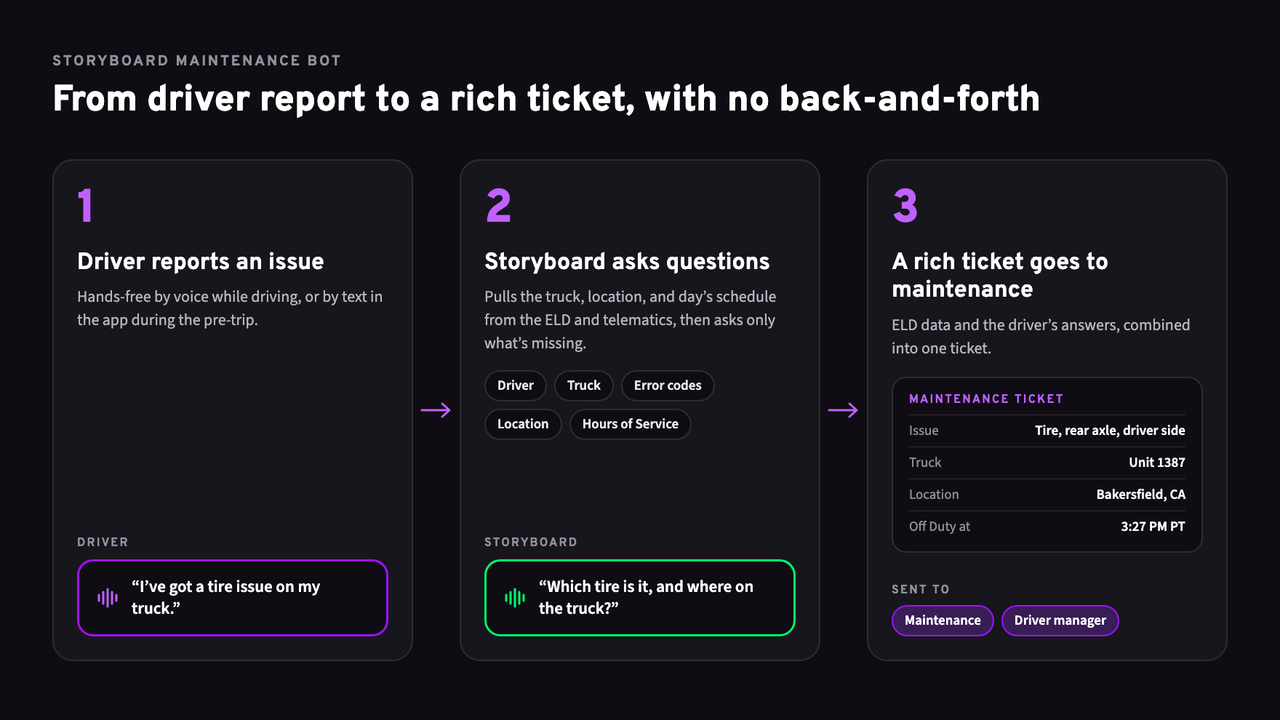
- The driver makes a request. Drivers can report an issue hands-free while driving. They can also use the app, such as during the pre-trip, to request maintenance by text.
- Storyboard does the heavy lifting and pulls in the data. It collects information from the telematics and ELD, including the driver's truck, potential issues, and the driver's schedule for the day. The driver doesn't need to repeat information in a form. Maintenance teams don't have to try to interpret ELD data.
- The bot fills in the gaps. If a request isn't complete, Storyboard asks follow-up questions automatically instead of waiting for maintenance to notice. A driver might say they have a tire issue. The bot asks which tire it is and which location the tire is in, details maintenance needs to act.
- Storyboard builds a rich ticket. It combines the ELD data with the driver's comments and answers into a single ticket.
- The ticket goes where it's needed. The ticket can be sent not only in Storyboard but to a maintenance email, if that is where the maintenance team is used to working. The driver manager gets the ticket as well so they have visibility to every ticket for the first time. Maintenance can reply if it's still needed so they get ready for action as soon as possible rather than waiting on responses from the driver or driver manager. Messages reach the driver immediately on the road.
Maintenance gets the information it needs to act faster, without the back-and-forth. Driver managers get the transparency that email and phone calls never gave them. Drivers get an easier way to report issues, whether they're in the yard or on the highway.
Keep maintenance requests from getting lost
The missed tire ticket wasn't a failure of effort. It was a failure of process: a request that was easy to lose, with little data attached and few people watching it.
Giving drivers a fast way to report issues, giving maintenance the ELD data up front, and giving driver managers visibility fixes all three at once. If you'd like to see Storyboard's Maintenance Bot in action, book a demo with our team.
See Storyboard's Maintenance Bot in action
Give drivers a faster way to report issues with visibility for managers