Fleet Operations6 min readOctober 22, 2026
Dwell Time and Detention Time in Trucking: Where Driver Productivity Leaks Away
Detention and dwell time quietly drain driver productivity. See where one major carrier lost hours and three ways fleets can win them back.
As FreightWaves recently highlighted, the average driver in America is driving just 6.5 hours of an available 11-hour clock. The rest of that clock is where driver productivity leaks away, and much of it is lost to dwell and detention time at shippers and receivers.
We see this pattern consistently. When Storyboard starts working with a new fleet on the operations side, the first step is to measure where utilization is being lost every day. We call that leakage: the places where drivers lose time, which hurts both their own pay and the carrier's revenue.
Recently, we analyzed a carrier's operations and found that a major source of leakage was dwell time and detention time. The analysis surfaced three distinct problems as shown by the daily averages of lost time:
- 250 hours of detention time daily where drivers were held past their appointment window.
- 145 hours of driver time lost on average waiting on an appointment window to open.
- 141 hours lost to drivers arriving late, which led to extra time being held and potential fees.
Dwell time and detention time are among the biggest levers a fleet has to increase revenue, improve the driver experience, and get more out of its people and equipment. Below, we cover what these terms mean, why they matter, and the three areas where we help fleets win hours back.
Why do dwell time and detention time matter?
Dwell time is the total time a driver and truck spend at a facility, from arrival to departure. It includes waiting, check-in, and loading or unloading.
Detention time is the extra time a driver waits at a customer facility beyond their scheduled appointment. Many carriers begin charging detention fees after the first two hours.
All three problems from our analysis are forms of lost dwell time, but they are not the same problem:
- Held past the appointment window is detention in the strict sense. The driver arrived on time and the facility ran late.
- Waiting on an appointment window is dwell time from drivers arriving early. Because the appointment hasn't started, this wait is generally not billable detention, so the carrier absorbs the cost.
- Arriving late is a dwell problem on the carrier side. A receiver may push a late driver back in the queue, and the resulting wait is usually hard to bill because the carrier missed the window.
The problem we saw in this fleet is representative of a gap across the industry. ATRI's 2023 data shows drivers reported detention at 39% of stops, rising to 56% for refrigerated drivers. Drivers lost 117 to 209 hours a year to detention depending on sector, and for-hire trucking lost more than 135 million hours in total. ATRI also found that 94.5% of fleets charge detention fees but are paid on fewer than half of those invoices.
The impact on your fleet can be even greater depending on the type of trucking you do or how many weekend deliveries are in your network. MIT's research found that most long-haul drivers reach their 6.5-hour driving average Tuesday through Thursday, but not on weekends.
Detention time: get visibility into the stops that cost you hours
Drivers being held beyond their appointment window is a major issue in trucking. One of the best assets a fleet can have is clear visibility into detention time, including the specific stops that have historically caused the most impact.
Working with fleets, we combine the driver's routing and schedule, GPS, and the driver's own feedback to identify when a driver may be in a detention situation. Storyboard checks in with the driver and reports back to managers automatically, so this happens consistently without relying on someone to notice or a driver to call in.
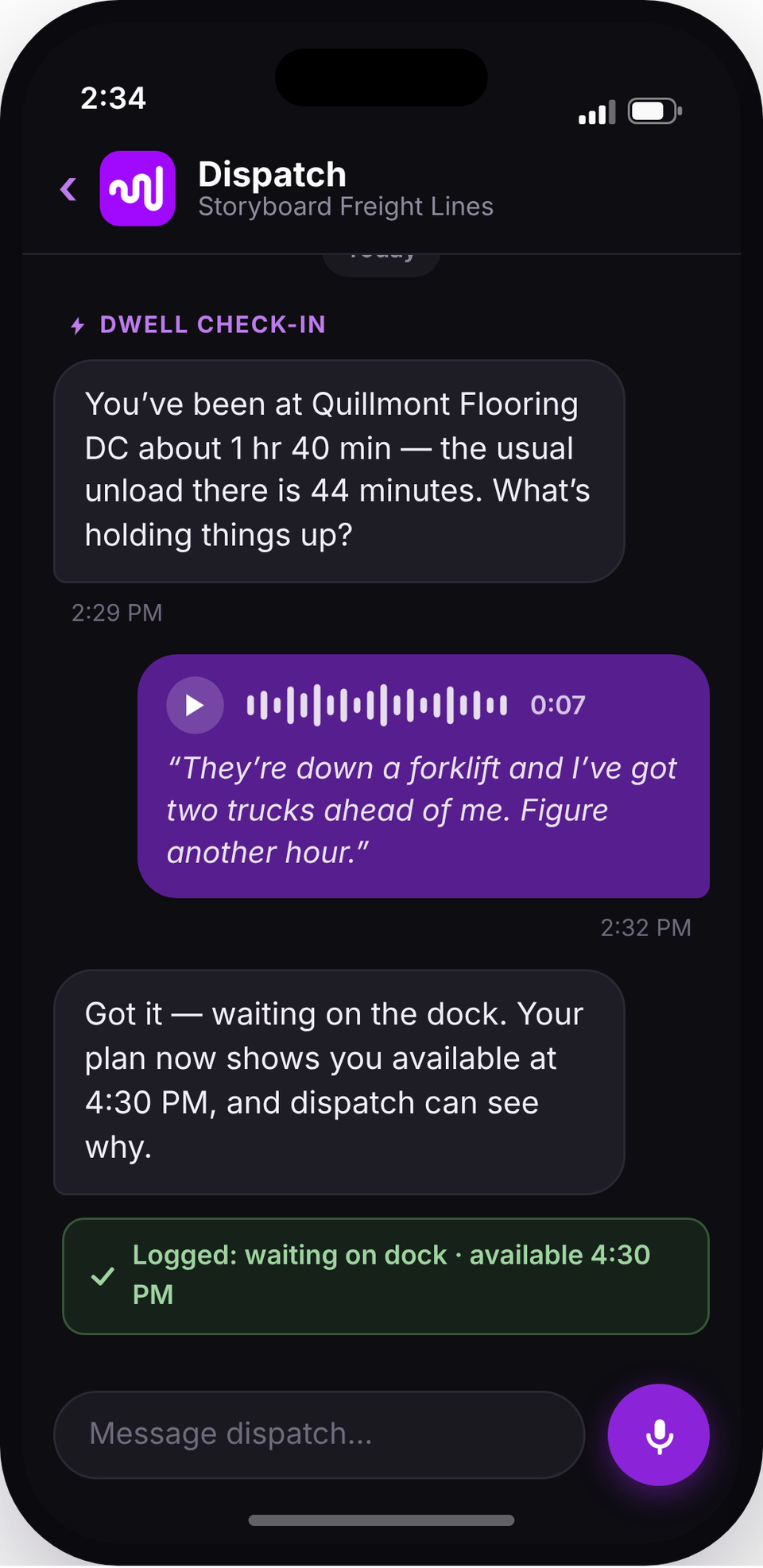
When detention is suspected, Storyboard can automatically ask the driver for the details needed to confirm it. That creates a ticket with the relevant information, which feeds into reporting so a fleet can see which stops and receivers consistently contribute to detention time.
That data does two jobs:
- Managing customers. A confirmed record of each event gives your team something concrete to bring to receivers about improving the problem.
- Planning future schedules. Known detention hotspots can be accounted for in advance, so the same receivers don't repeatedly hold up a driver's schedule.
Having the data is the first step in solving the problem.
Drivers waiting on appointment windows
If your fleet runs with appointment times, drivers who arrive early may not be unloaded until their slot opens. The driver's 14-hour clock keeps running while they wait, and the carrier typically can't bill that time as detention. We target this in two ways.
Driver ETAs in the Storyboard dashboard. When the office can see when each driver will arrive, it can spot an early arrival before it happens. If a driver is going to arrive much too early, dispatch has options, depending on the customer and the freight:
- Ask the receiver whether it accepts early deliveries, or whether an earlier slot is open.
- Use the gap productively, with a fuel stop, a break, or rest before reaching the facility, instead of waiting in the lot.
- Re-sequence the plan, for example by moving another stop or load ahead so the driver's time goes to freight rather than a dock.
Helping drivers confirm their appointments. Drivers have a lot to do besides driving. With Storyboard's Dispatch Bot, a driver can ask when their appointment is and whether the customer allows early delivery, which makes it easier to plan the day without calling the office.
A critical point is that Storyboard is accessible hands-free, so drivers can get this information even when they cannot safely look at their dispatch instructions or printed paperwork.
Drivers arriving late
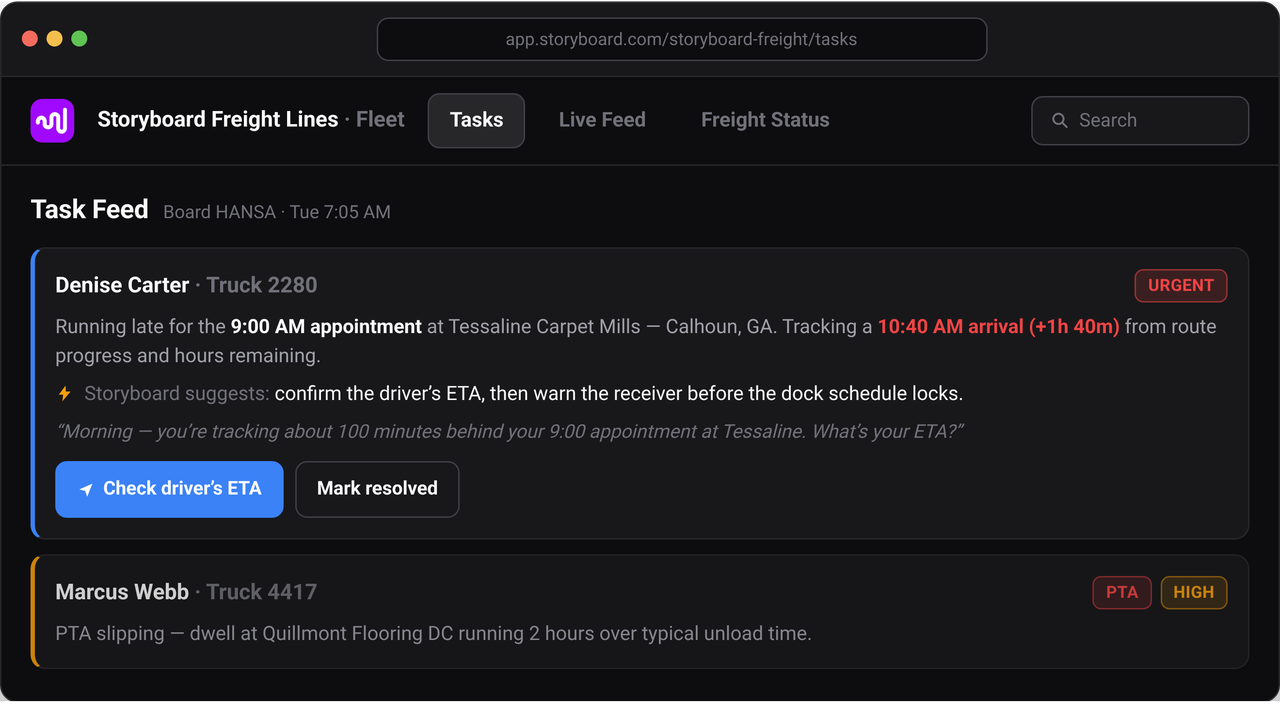
When a driver arrives late to a stop with an appointment, it is a common cause of lost time and extended delays. The best fix is to see the problem before it happens. We use two strategies.
Predictive ETAs for dispatchers and driver managers. With our Predictive Dispatch workflow, managers see every scheduled stop on a driver's schedule, with a prediction of whether the driver will arrive on time. The prediction uses the driver's location, remaining hours of service, and traffic.
Tasks for at-risk loads. Potential late arrivals can become tasks in Storyboard, so driver managers can quickly identify the loads at risk and start working with the driver or the customer to limit the impact.
This approach also protects the customer relationship. Instead of discovering a late arrival after it has caused a problem at the receiver, your team can be proactive, with better data in hand.
Win back driver productivity
Detention and dwell time rarely show up as one big number on a report, which is why these issues are often hard to prevent without clearcut data. They show up as a late arrival here, a long wait at a dock there, and a driver who ends the day well short of their available hours. Measuring where those hours go is the first step, and it points to specific fixes: better visibility into detention, earlier action on early arrivals, and fewer late arrivals.
Want to find ways your fleet can reduce detention and dwell time every day?
See where your drivers' hours go, and how Storyboard flags detention, early arrivals, and late loads before they cost you.